NEWSLETTER
03/2026
Managing financial risk for CO₂ infrastructures
Investing in CO₂ capture, transport, storage and use (CCUS) requires coordination for the build-up of a whole new and cross sectorial value chain and effective de-risking strategies
The cement industry in Europe is committed to achieving carbon neutrality, including the use of CO₂ capture. While many projects have been proposed, it is obvious that the development of CO₂ infrastructures and related final investment decisions pose significant hurdles for the scale-up of CCUS. These must be overcome by addressing multiple investment risks in the CCUS value chain. Timely coordination of CO₂ transport across borders and industrial sectors is required.
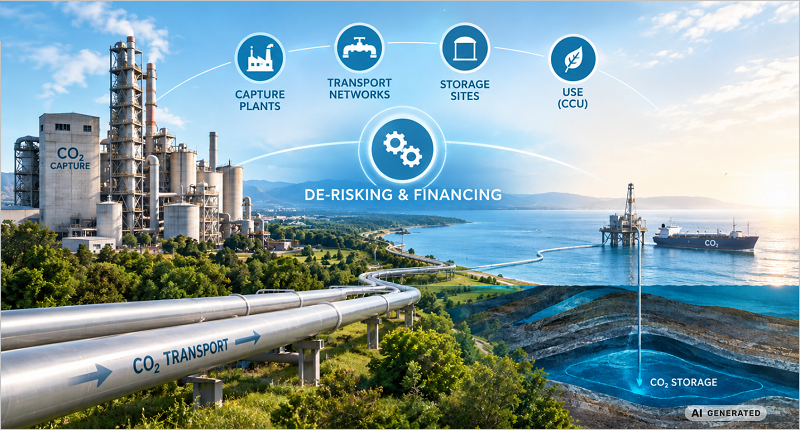
The deployment of CCUS in Europe at scale requires the construction of extensive CO₂ infrastructures, including capture plants, CO₂ transport networks, particularly pipelines, and geological storage for CO₂. For a CO₂ capture plant, it is essential that the CO₂ infrastructure becomes available on time for the start of operations without delay. In many inland regions, the development of pipeline-based CO₂ transport will be key to achieve sufficient CO₂ transport capacity and cost efficiency. A high level of collaboration across borders and a pan-European perspective on CO₂ infrastructure development will be required to meet European climate neutrality targets. This has been clearly formulated in decarbonisation strategies for cement and concrete, as well as for other sectors with unavoidable CO₂ generation in their processes.
For all elements of a CCS value chain, the scaling up will require significant upfront investments and public support, at the beginning of the scale-up phase. Final investment decisions are mutually dependent and must be based on long-term certainty regarding the added value of CO₂ mitigation by CCS. A clear perspective is needed to ensure that existing counterparty risks are adequately addressed and that the costs can be accommodated within the value chains, ultimately being covered by users of decarbonised industrial products.
Joint Need for De-Risking Investments
Managing the financial risks of high and long-term industrial investments requires a joint perspective of the risk elements involved and how they can be addressed effectively:
- So-called default risks are related to the unavailability of CO₂ infra-structures for CCS operations.
- An intertemporal financing risk is to be borne by network operators when taking FID at times of an un-certain future demand.
- And there are important risks relat-ed to the political target-setting, the demand for CCS, and the co-ordination of the new and complex CCUS value chains.
These risk elements cannot be controlled by private actors alone. Thus, the necessary investments require dedicated political strategies to reduce risks and finance the deployment of CCS infrastructures at an early stage. Such strategies must involve policy coordination and a fair sharing of risks between public and private actors, as well as public funding. At the same time, it seems possible to pool the public and private interests in CCS in a positive way, thereby minimising the need for public funding.
De-risking and financing strategies to enable the build-up of CO₂ Infrastructure
Support, Funding, and Guarantee Mechanisms
Various solutions and combinations of financial instruments have been used for the initiation of CCS in several European countries. The initial build-up of new infrastructures has been successful in very few clusters, where adequate funds and/or guarantee mechanisms were established by policymakers, to absorb significant shares of the default and intertemporal risks. A supporting mechanism such as carbon contracts for difference (CCfD) is necessary to build a business case for investments and to address operational costs on behalf of the CO2 emitter, as long as the cost of CCS is significantly higher than the relevant EU ETS CO₂ price.
At the same time, additional support instruments are needed in order to mitigate some of the long-term uncertainty and to support the coordination of the CO₂ infrastructure development.
Fundamental uncertainties involve the future climate policy developments and default and intertemporal risks associated with building new infrastructure or carbon capture plants. If these are managed and a sufficient level of de-risking can be assured, institutional financing and senior debt can be mobilised to provide upfront financing for the CO₂ infrastructure investments. Risk management services provided by insurance companies can play an additional role. However, the primary de-risking must be achieved by designing appropriate instruments for pooling the joint public and private interests in creating the CO₂ infrastructures for CCUS in Europe.
ECRA has scheduled an online seminar on 5 October 2026 in which different approaches for de-risking investments in CCS projects and CO₂ infrastructure will be discussed. In this exchange, first experiences of early mover projects will be presented. The seminar will also address the financial risk of cross-border CO₂ infrastructure development, as well as the roles of public and private actors across Europe.
> Learn more about our new online seminar "De-Risking and Financing Instruments for Cross Border CO₂ Infrastructure" on 5 October 2026