NEWSLETTER
02/2026
AI in cement manufacturing: From today’s applications to tomorrow’s autonomous systems
Exploring opportunities, challenges and practical pathways for scaling AI across the cement industry
The use of AI and machine learning creates new opportunities across all industrial sectors. Today's AI applications range from prediction and classification to sophisticated agentic platforms that can operate with a high degree of autonomy. But how do these technologies come together, and what real benefits will they bring to the future of the cement industry?
Today, Artificial Intelligence (AI) can write natural, human-readable text in almost any language, generate computer programs, and starts to interact with computer systems autonomously. Beyond these capabilities, AI can also identify patterns, classify complex information, and predict values and outcomes in industrial processes. AI is here to stay and is increasingly supporting us in our daily office work, maintenance activities, and industrial production, including cement manufacturing.
Challenges and barriers for AI usage in cement plants
Besides human factors and the acceptance of AI-generated recommendations and decisions, a lack of scalability remains one of the major obstacles to the widespread integration of AI applications in the cement industry. Every cement plant is unique. Differences in plant design, equipment, automation systems, operating strategies and raw materials make it difficult to develop standardised AI solutions that can easily be transferred from one site to another. Consequently, many AI applications still require significant adaptation and customisation before they can be deployed at scale.
Another major challenge is the availability and accessibility of data. Process data and various types of historical information are often unavailable, stored in isolated systems, or linked to one another in a non-standardised manner. Relevant information may be distributed across process control systems, laboratory systems, maintenance databases, spreadsheets and other sources. This fragmentation makes it difficult to create a consistent and reliable data foundation for AI applications.
In addition, challenges related to the underlying IT and OT infrastructure can limit the implementation of AI solutions. Legacy systems, limited connectivity and interfaces, and tools that cannot easily be integrated with existing systems can create significant barriers. The integration of new AI applications into established operational environments therefore remains a major technical challenge.
Taken together, these challenges show that scaling AI in cement manufacturing is not simply a matter of selecting and deploying more advanced AI models. The ability to scale AI applications depends equally on the availability of reliable data, interoperable IT and OT infrastructure, standardised processes, effective knowledge management, and clear governance structures. In many cases, these foundations are still evolving.
At the same time, the technological landscape is changing rapidly. Advances in machine learning, data integration, industrial AI platforms, and AI agents are creating new possibilities to address some of these limitations. Instead of developing isolated, highly customised solutions for individual applications or plants, the focus is increasingly shifting towards AI systems that can be integrated more easily, reuse existing knowledge and data, and adapt to different operational environments.
This raises an important question: how can these technological developments help overcome today's barriers and enable AI to scale across cement manufacturing?
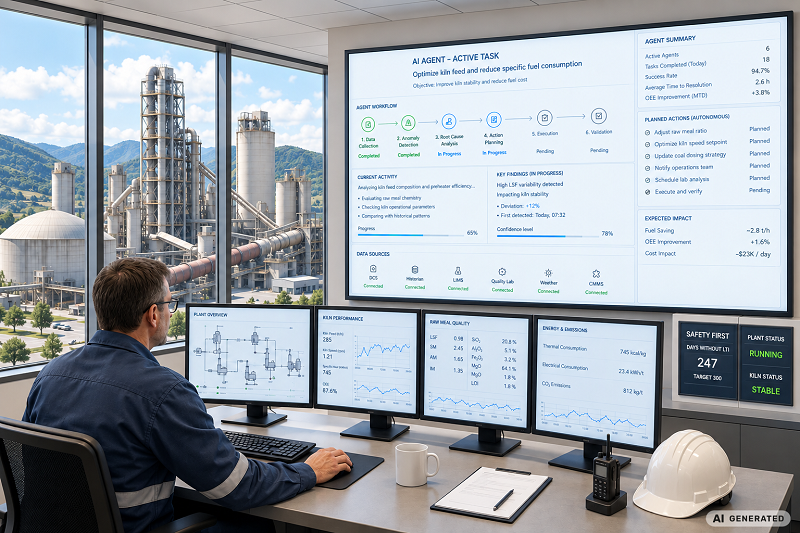
From data to decisions: How AI agents could support the future of cement manufacturing
Looking ahead: Scaling AI in cement manufacturing
Recent technological developments provide encouraging prospects for overcoming many of the current barriers to AI adoption in the cement industry. More powerful and accessible machine-learning models, improved data-integration technologies, and emerging approaches such as Industrial AI platforms and AI agents are creating new opportunities to develop solutions that are more scalable and easier to integrate into existing cement-plant environments.
In the future, increasingly capable AI systems, potentially including forms of artificial general intelligence (AGI) and expert AI models, could complement specialised machine-learning models rather than replace them. While machine learning can analyse process data, generate predictions, identify patterns, classify process disturbances, and support forecasting, AI agents and AGI-like systems could help combine these capabilities across different plant areas and interpret them in a broader operational context. Such systems could support the early detection and classification of process disturbances, forecast their potential development, identify likely causes, and recommend appropriate responses based on historical data, process knowledge, and real-time operating conditions. They may also be able to assist in the transfer of knowledge between plants, as well as adapting AI applications to the specific characteristics of individual production environments.
However, the use of AGI in industrial applications remains an emerging prospect and will require careful validation, transparency, cybersecurity, and human oversight. Successful implementation will depend on more than technological progress alone. Cement manufacturers will need to combine advanced AI capabilities with organisational change, standardised processes, effective data governance, and a strong digital and data infrastructure. Companies that establish these foundations will be better positioned to integrate machine learning, predictive analytics, disturbance classification, forecasting, and future agentic capabilities, thereby scaling AI applications and realising sustainable value from their data and AI investments.
> Learn more about our new online seminar "AI in the Cement Industry: Insights, Opportunities and Challenges" on 1 October 2026
... where AI start-ups will share their key learnings, future trends, technical insights and practical recommendations for creating greater value from AI in cement manufacturing.