
NEWSLETTER
01/2026
Advanced combustion technology
The impact of novel technologies to reduce carbon emissions
Modern kiln systems are undergoing a fundamental transformation. This development is driven by higher alternative fuel substitution rates, stricter emission limits, and the need for greater operational flexibility. As a result, combustion in the cement industry is shifting from conventional coal firing toward more integrated and resource-efficient energy systems.
At the core of this evolution are advanced fuel preparation and feeding concepts, such as pyrolysis-based systems, which enable the conditioning of challenging alternative fuels into more homogeneous and reactive energy carriers.
Innovative pre-treatment and circular economy concepts
Technologies like the PyroRotor and FuelFlex Pyrolyzer illustrate how mechanical, thermal, and chemical pre-treatment can enhance fuel quality, improve flame stability, increase substitution rates, and reduce the operational risks associated with direct firing of heterogeneous waste-derived fuels.
In parallel, the integration of circular economy concepts is expanding the role of combustion systems beyond energy supply. Processes such as FlashPhos demonstrate how high-temperature cement process environments can be leveraged for the recovery of valuable resources, transforming industrial residues into secondary raw materials while reducing dependency on primary resources and creating new sustainability-driven value streams.
The potential of hydrogen for advanced combustion
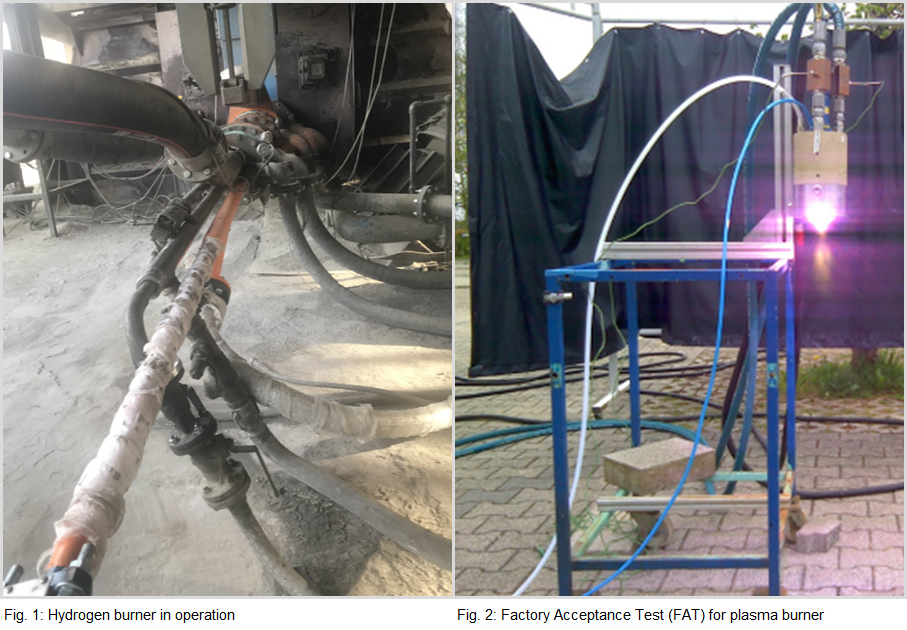
Hydrogen is emerging as a complementary tool within advanced combustion concepts, not primarily as a standalone fuel, but as a targeted flame enhancer. Even small hydrogen additions can significantly influence ignition behavior, flame geometry, and heat transfer, offering new degrees of freedom for stabilising combustion under highly flexible fuel conditions and for supporting emission reduction strategies (Fig. 1). These developments are increasingly supported by advanced simulation tools, such as Computational Fluid Dynamics, which allow detailed analysis of flame dynamics, mixing behavior, and temperature fields, enabling data-driven optimisation of burner design and operational parameters before implementation in full-scale kilns.
Decarbonisation through electrification
Beyond chemical and fuel-based innovations, electrification represents a longer-term structural shift in cement process design. Electrically heated systems and hybrid process concepts are being explored as pathways toward deep decarbonisation, with implications for plant layout, energy infrastructure, and the integration of renewable power sources (Fig. 2). In this broader context, novel energy carriers such as metal fuels are also gaining attention. By utilising recyclable metal oxidation and regeneration cycles, these concepts offer a potential route to carbon-free high-temperature energy supply, opening new perspectives for future low-carbon cement production.
From conventional to advanced combustion
Together, these technological developments reflect a transition from conventional combustion toward highly integrated, flexible, and resource-efficient energy and process systems, positioning advanced combustion technology as a central pillar in the cement industry’s pathway toward sustainability, resilience, and long-term decarbonisation.